


Quick Answer: Regular, timely maintenance keeps small problems from turning into expensive ones, keeps tenants and buyers happy, and helps your building’s major systems last longer. Studies show well-maintained properties gain about 1% in value each year, while neglected ones can lose up to 10 to 15% over time.
If you own a property in Abu Dhabi, you already know the weather is not kind. Heat, humidity, and sand wear things down fast. A building that looks perfectly fine today can have cracked seals, a leaking pipe, or a failing AC unit within a single season if nobody checks on it. That is really what this article is about. Maintenance is not just upkeep. It is one of the main things that decides how much your property is worth years from now.
Let us go through why that is true, what happens when maintenance gets skipped, and how to build a simple habit around it that actually pays off.
Why Maintenance Affects Value So Directly
Every building has parts that wear out. Roofs age. Pipes rust. AC compressors get weaker. Paint fades. None of this is surprising if you have owned a property for a while. What decides whether your property holds its value or loses it is how fast these small issues get noticed and fixed.
Researchers from the University of Connecticut and Syracuse University found that steady maintenance adds around 1% to a property’s value every year. That does not sound like much on its own, but add it up over ten years and it becomes a real difference between a property that grows in value and one that just sits there.
The opposite is also true. Data from property management studies shows that neglected buildings can lose up to 15% of their value. And it is not just the number that suffers. Buyers and appraisers do not just look at the size of a property. They look at the roof, the age of the AC, the plumbing, and whether there are maintenance records to prove the place has been looked after. A clean maintenance history tells a buyer or a bank that the property has been cared for, and that usually means a better offer.
Waiting Almost Always Costs More
Here is something a lot of owners learn the hard way. Fixing something after it breaks costs more than fixing it before it breaks. When a problem becomes an emergency, you are paying for rushed labor, after-hours callouts, and often extra damage the ignored issue caused along the way.
A small roof leak, left alone, can soak insulation, ruin drywall, and eventually reach the wiring. A minor AC fault in an Abu Dhabi summer can turn into a full compressor failure in a matter of weeks, since these units barely get a break for months at a time. Some industry estimates put emergency repairs at three to four times the cost of the same job done on a planned schedule.
There is also a cost that is easy to miss: tenants leaving. Properties with poor maintenance see much higher turnover. One study found tenants stay about 50% longer in properties known for solid maintenance, and how a tenant’s first year of maintenance requests can shift renewal rates by more than 13 percentage points. Every time a tenant moves out, you are paying for the empty unit, the cleaning, the marketing, and the time it takes to find someone new. Good maintenance quietly protects that income the whole time it is happening, even if you never notice it working.
Reactive vs Preventive Maintenance, Side by Side
The easiest way to see the difference is to look at both approaches next to each other.
| Factor | Reactive (fix it when it breaks) | Preventive (planned and scheduled) |
| Repair cost | Higher, often 3 to 4 times more per job | Lower and predictable |
| Property value | Can drop by up to 15% over time | Can rise by about 1% a year |
| Tenant retention | Lower, more complaints and move-outs | Higher, tenants stay around 50% longer |
| Lifespan of systems | Shorter, wear goes unmanaged | Longer, closer to the full rated life |
| Budgeting | Unpredictable, hits you at the worst time | Steady, easy to plan for |
| Emergency risk | High, breakdowns come without warning | Low, issues get caught during checks |
| Resale outcome | Weaker offers, slower sale | Stronger offers, faster sale |
This is basically why more property owners and managers in the UAE are moving toward scheduled maintenance instead of waiting for something to fail. It is not about spending more money. It is about spending it at the right time.
What “Timely” Actually Means Day to Day
Timely does not mean doing something every week. It means having a rhythm that fits how your property ages and how the local weather treats it. For most properties in Abu Dhabi, that usually looks like this:
AC servicing before summer, not during it. Filters, coils, and refrigerant levels need a check well ahead of the heat, since AC systems here run almost nonstop for months once summer starts.
Plumbing checks on a regular basis. Hard water and pressure problems are common in this region, and a small leak inside a wall is one of the most expensive things to leave alone.
A yearly walk-through of the exterior and structure. Sand, heat, and humidity wear down paint, seals, and rooftop waterproofing faster than people expect. Catching this early keeps it cheap to fix.
Electrical safety checks. Old wiring and overloaded circuits are a safety concern as much as a value concern, and both insurers and buyers take this seriously.
If you want to see what a full maintenance plan looks like in this market, our guide on property maintenance in Abu Dhabi covers it property by property.
Villas Deal With Their Own Set of Problems
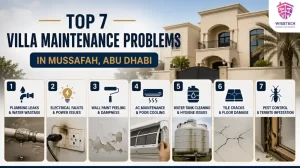
Villa owners face a different set of issues than apartment owners, mostly because a villa has its own AC units, its own plumbing, its own roof, and often a garden or pool to look after too. In areas like Mussafah, where a lot of Abu Dhabi’s villas are located, the same problems tend to show up again and again: AC drainage issues, contaminated water tanks, roof waterproofing that fails, and electrical faults from older wiring.
We went through the most common ones in our article on villa maintenance problems in Mussafah, along with what usually causes them and how to spot them early.
Planned Preventive Maintenance Is What Actually Protects Value
The table above shows why reacting to problems is the expensive route. The better option is Planned Preventive Maintenance, usually called PPM. It is basically a set schedule of inspections and servicing built around how old each system in your property is and what condition it is in, instead of waiting for something to break or a tenant to complain.
A typical PPM schedule covers AC servicing, plumbing checks, electrical inspections, fire safety systems, and structural checks, all timed to match manufacturer guidelines and how tough the local climate is on each part of the building. Properties on a PPM plan tend to have fewer emergencies, lower total maintenance costs over time, and hold their value better because everything is working closer to how long it is actually supposed to last.
If PPM is a new idea to you, our guide on how Planned Preventive Maintenance works and why it matters explains how a program like this gets built and what kind of return you can expect from it.
Who Handles the Work Matters Too
A good schedule only works if the people doing the work are reliable. This is where a lot of property owners lose value without realizing it. Calling a different handyman every time something breaks might seem cheaper right now, but it usually means no records, no consistency, and nobody accountable if the same problem happens twice.
A proper property maintenance company brings a structured process, trained technicians for each system, documentation for every job, and one point of contact instead of a rotating list of random workers. That documentation ends up mattering a lot more than people expect. When you sell or refinance later, a clean maintenance history is one of the strongest things you can show an appraiser or a buyer.
If you are trying to decide who to hire, our guide on choosing a property maintenance company in Abu Dhabi covers what to look for, what to ask, and the red flags that mean a provider will end up costing you more than they save.
The Bottom Line
A property’s value is not just about its location or how nice the finishes look. It comes down to condition, and condition comes down to how consistently the place has been maintained. The numbers back this up. Well-maintained properties gain value steadily, keep tenants longer, sell faster, and avoid the piled-up costs that come from ignoring small problems.
Timely maintenance is not money you lose. It is one of the few things in real estate that pays you back in almost every direction at once, higher value, lower repair bills, better tenants, and an easier sale whenever you decide to move on. The properties that hold their value best in Abu Dhabi are rarely the newest ones. They are the ones someone has been quietly taking care of, season after season, for years.
Ready to Protect Your Property’s Value?
If your maintenance plan has been more reactive than planned, now is a good time to change that before another summer puts your systems to the test. Here is where to start:
- Get a clear picture of what full-service property maintenance in Abu Dhabi should cover for your building:
- Not sure who to trust with the work? Read our complete guide to choosing a property maintenance company in Abu Dhabi before you sign anything:
- Want to stop reacting to breakdowns altogether? Learn how a Planned Preventive Maintenance program works and what it can save you over time:
Reach out to Wisetech Maintenance today for a property assessment, and let us help you build a maintenance plan that keeps your asset’s value working for you, not against you.